Are you wondering whether automation will actually pay off in your company—before placing an order and paying a deposit? It’s one of the most common questions we hear from production managers and plant owners. And it’s a good one to ask.
An automation decision often involves an investment of several hundred thousand złoty—or even several million. It should be based on numbers, not intuition.
In this article, we show you step by step how to conduct a reliable ROI calculation before implementation: which metrics to collect, how to build a financial model, and what pitfalls to watch out for in your calculations.
Many companies decide to automate due to market pressure, labor shortages, or enthusiasm for new technology. That’s not necessarily wrong—but without solid data, it’s easy to make costly mistakes:
A thorough pre-implementation analysis serves three purposes:
Step 1: Measure the Actual Cost of Your Current Process
Before calculating potential savings from a robot, you need to know how much the lack of automation currently costs you. This is the starting point for any ROI calculation.

Direct Costs of Manual Processes
Primarily:
In Poland, the monthly cost of employing one production worker currently ranges from PLN 8,000 to 14,000 (gross salary plus employer costs). For three-shift operations, that amount triples.
Hidden Costs (Often Overlooked)
Create a simple table using data from the past 12 months (wages, scrap, downtime) and calculate the total annual cost of the process you want to automate. This is your baseline.
Step 2: Define the Total Cost of Automation
The Total Cost of Ownership (TCO) includes much more than just the price of a robot.
One-Time Costs (CAPEX)
Operating Costs (OPEX)
Reliable robotic system suppliers should provide a detailed TCO breakdown at the quotation stage. If you only see the hardware price—ask for the rest.
Step 3: Calculate ROI – Formula and Example
Basic ROI Formula
ROI (%) =[[(Annual Net Savings – Annual OPEX) × Years of Use – CAPEX] / CAPEX × 100]
In practice, companies more often use the Payback Period:
Payback Period = [CAPEX / (Annual Net Savings – Annual OPEX)]
Example Calculation
A food production plant employs 3 operators for manual palletizing per shift. With three shifts, that requires 9 employees.
Total annual labor cost:
9 × PLN 11,000 × 12 = PLN 1,188,000
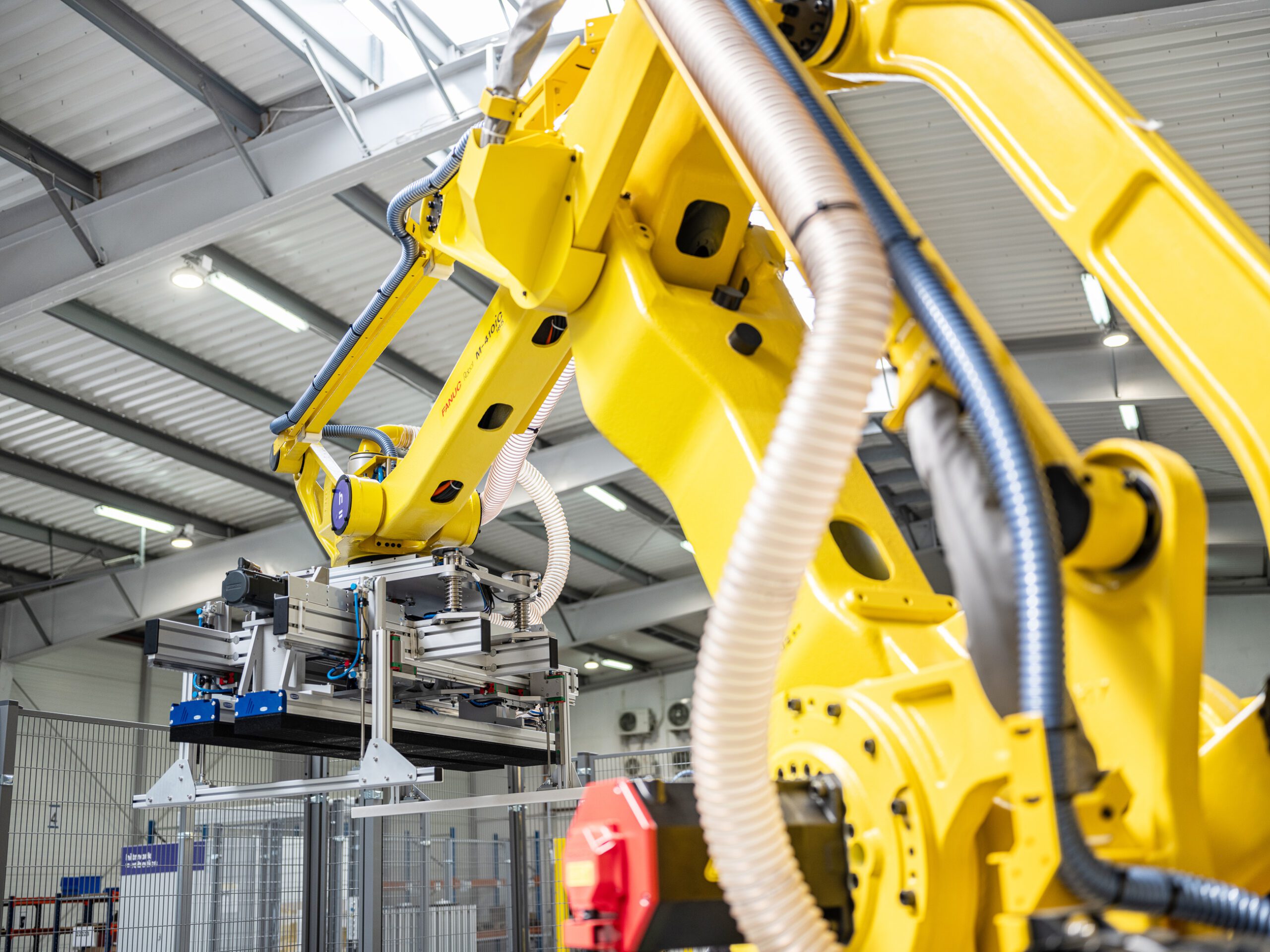
Cost of implementing a robotic palletizing system (robot, integration, line): PLN 680,000
Annual OPEX (service, energy): PLN 35,000
Annual net savings:
1,188,000 – 35,000 = PLN 1,153,000
Payback Period:
680,000 / 1,153,000 ≈ 0.59 years (approximately 7 months)
This is a simplified calculation—it does not include ramp-up time or employee reassignment—but it clearly illustrates the scale of potential benefits.
In similar projects implemented for clients of Hitmark Robotics, the payback period typically ranges from 12 to 36 months.
Step 4: Key Metrics Beyond ROI
ROI alone does not provide the full picture. Complement your analysis with additional indicators:
OEE (Overall Equipment Effectiveness)
A composite indicator of availability, performance, and quality. A robot operating 24/7 with 99.9% repeatability significantly improves OEE compared to manual processes.
An increase of just 10 percentage points in OEE at a plant generating PLN 20 million in annual revenue can translate into PLN 1.5–2 million in additional production value per year.

Cost Per Product (CPP)
After automation, this metric should decrease noticeably. Track it to verify your forecast assumptions.
Defect and Complaint Rate
Robots eliminate errors caused by fatigue or inattention. Reducing defects from 2% to 0.2% in annual production of 1 million units can generate savings of tens of thousands of złoty.
Line Uptime
Manual stations depend on attendance, sick leave, and staff turnover. Robots operate according to the production schedule—with planned service windows.
Step 5: Consider Often-Ignored Factors
A proper ROI calculation should also account for less measurable—but very real—benefits:
Scalability Without Proportional Cost Growth
Increasing production volume by 30% with manual palletizing means hiring additional staff. A robot can handle increased volume without proportional labor costs.
Independence from the Labor Market
Finding workers for repetitive production tasks—especially night shifts—is increasingly difficult in Poland. Automation reduces operational risk related to labor shortages.
Safety and Ergonomics
Workplace accidents, occupational diseases, and employee claims generate real costs. Robots take over physically demanding and hazardous tasks—reducing insurance premiums and legal risk.
Grants and Tax Incentives
In Poland, EU funding (including programs under KPO and regional initiatives) may be available. Investments in robotics may also qualify for preferential depreciation. Including these factors can shorten the effective payback period by 20–30%.
Common Mistakes in Automation ROI Calculations
Based on experience from robotics projects, companies most often make mistakes in the following areas:
How to Get Started – A Practical Next Step
If you’re reading this article, you likely have a specific process in mind for automation.
The best first step is not requesting quotes—it’s gathering the data described above:

With this data, conversations with a robotics integrator become concrete and partnership-driven—not purely commercial.
At Hitmark Robotics, we regularly help clients go through the pre-implementation analysis phase before any formal offer is made. We conduct process audits, model financial variants, and present realistic return-on-investment scenarios based on data from similar implementations in Poland.
If you would like to check whether automation makes sense in your case—contact us. No obligations, just real numbers on the table.

Hitmark Robotics is a Polish robotic systems integrator specializing in palletizing, depalletizing, and production line automation. We deliver projects for the food, chemical, construction, and many other industries—with a strong focus on measurable business results.